

Purchase Tickets


Witchy Woman
December 16, 2025
While processing a collection from an individual, it’s not unusual for an archivist to form a mental attachment to them, and a unique feeling of familiarity with them. While sorting out someone’s private papers, letters, and photographs and researching their lives and family histories, it can be hard not to — especially when you come across something personal. Recently, while processing my last collection as an archivist at the IHS, I had such an experience. A young mother slowly dying of tuberculosis, watching her toddler son grow but knowing she would not be there for him, wrote a touching goodbye.
The Dawson family collection, also known as the G.G. Dawson Papers, has been in the IHS collections since 1980. The collection came from a family of medicine show performers based in Indiana from the 1890s up until about the World War I period. G.G. Dawson, who also went by Harry, was a blackface performer and banjo player for shows like the Herbs of Life Medicine Company.
We recently received an addition to the collection, a ledger which had been used by Dawson’s first wife, Carrie [Miller] Dawson, to record her poetry. Poetry was a common hobby in the 19th century, and Carrie copied her work dating back to her teenage years into the ledger. She seems to have had a reflective and wistful nature, and wrote poems with titles like “By the Sad Sea Waves” and “The Love of Long Ago.”
Carrie married Harry in 1891 when she was about 19, and he was 29. Carrie, who was seemingly raised in a performing family, joined her husband’s show as a guitarist. In 1893, they welcomed a son, A.L. “Leon” Dawson.
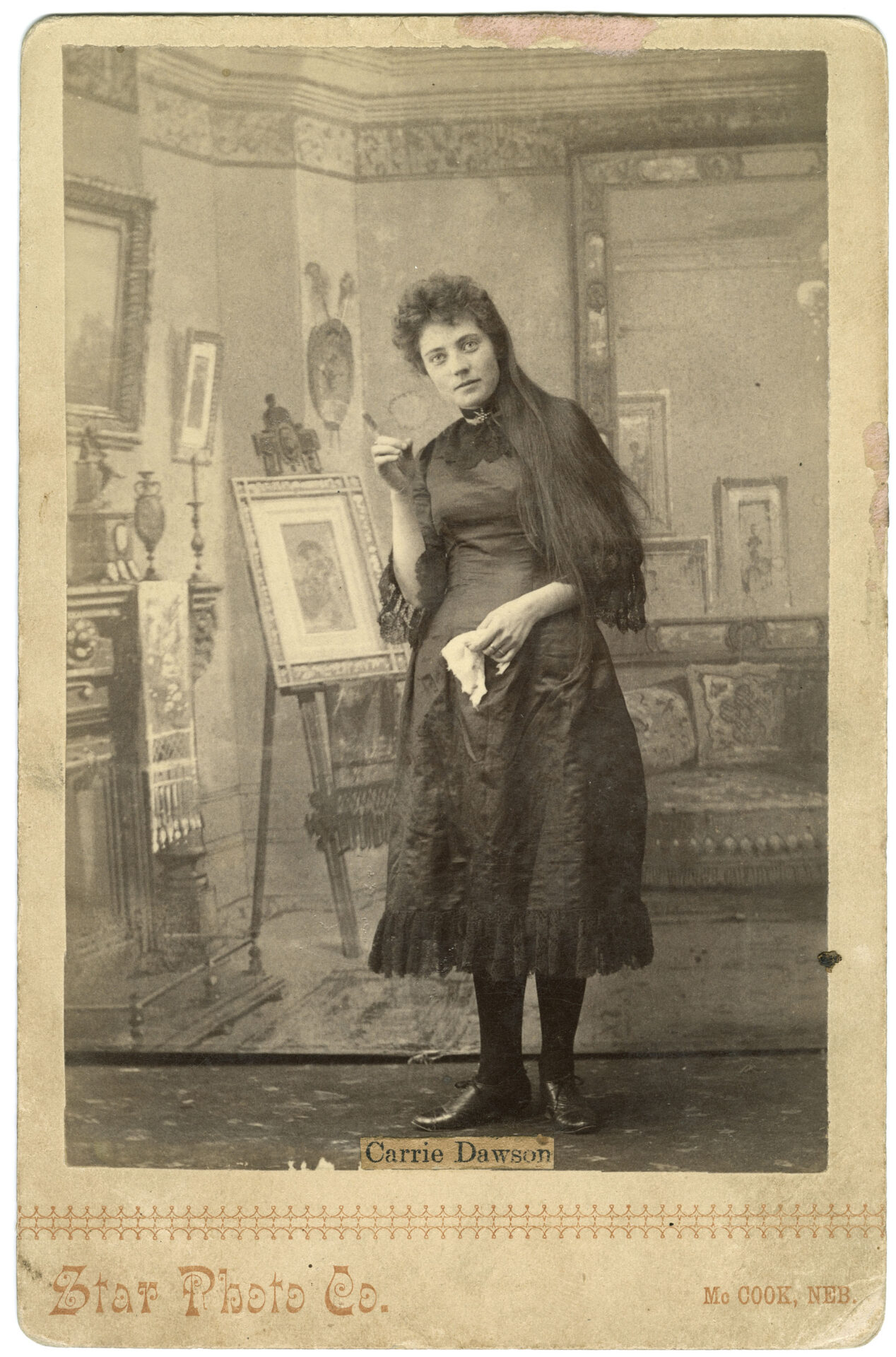
In the existing collection, I found the photographs of Carrie seen here. Her appearance seemed to match her rather melancholic words—dark hair and very pale eyes, in a black silk and lace dress, possibly in mourning (a sister of hers died in 1891), with very rigid, deliberate poses. I began to imagine her as a somber, creative type like Oscar Wilde or Lydia Deetz from Beetlejuice.
I also found in the existing collection a few letters Carrie wrote to her husband while she was caring for their sick child and he was on tour. She added to her mystique when I read her words from Morton’s Gap, Kentucky in 1895, “I got the money [you sent] all O.K. and many thanks for same, but as it happened I did not need it. […] I made $1.50 on fortunes at 25 cents each.” I recalled that in her ledger, Carrie had written a poem about telling fortunes as a child by “reading” daisy petals that she had sprinkled on the ground.
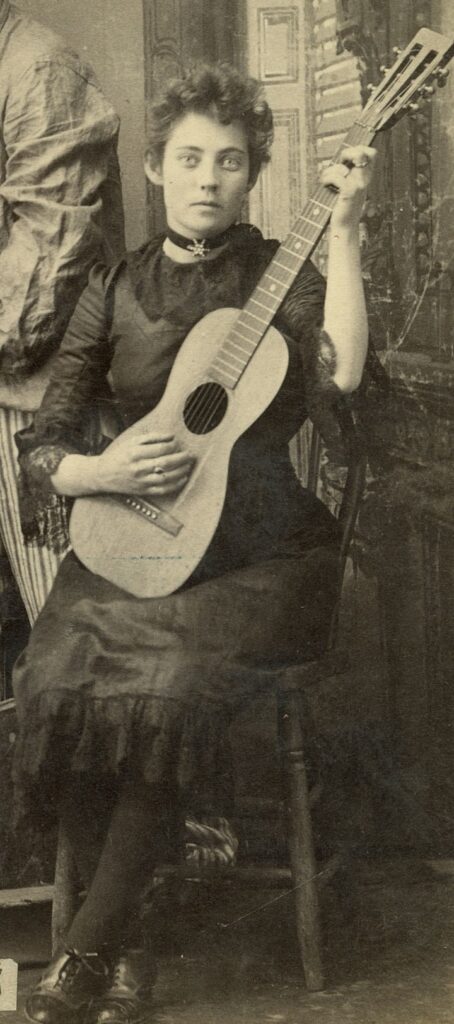
Dawson Family Collection, M0333
Soon after that, Carrie contracted TB, at that time called consumption. In May of 1897 she wrote to Harry, “Dr. B– said in his last visit, I must leave the city entirely or I would be within the shadows. He didn’t say it in so easy a way but mighty blunt.” Four months later, she died. She was only 25. Leon was 4. She is buried at the Russiaville Cemetery in Howard County.
A year before her death, with the symptoms of the “wasting disease” bearing down on her, she had written in the back of her poetry ledger,
Leon, my beloved son, the contents of this book has been the work of about ten years. The aspiration and ambition to be something other than an ordinary plodder I bequeath to you.
While I write this, you sit beside me too young to understand the deep love and tenderness that fills my heart for you. My tears are not so much that I know that soon I shall have to leave you, as that I fear I shall not be able to help you in the struggle which lies before you.
She goes on to write her hopes for Leon and offers him advice on navigating life. She encourages him to be brave, keep high standards, and maintain integrity: “No matter whether your work be popular or not, work only for the good of some suffering fellow man.” She expounds on her views on God and science before closing, “This may not be a fitting finale to my Poems. Yet I do not claim any merit for them, only as a memento of the young mother who loved you dearer than life.”
As my time at the IHS comes to an end, I wanted to leave this example of the innumerable life stories contained within our collections. It has been an honor to work with them, rediscover them, and share them.