


Purchase Tickets


Hoosier is a French Word?
March 5, 2026
What is a Hoosier? Its origins are something that has challenged the best historians and linguists. There are multiple theories, but none seem to provide a satisfactory answer. In 2024, a brief conversation challenged my perspective of its origin. And if so, it could have originated a century before it was used in John Finley’s 1833 Poem, “The Hoosier Nest”?
So rightfully, I am adding another theory to this beloved Indiana mystery.
A Few Theories of Where Hoosier Came From:
There have been multiple theories of the etymology of the term Hoosier, most tracing its origins to English-speaking people. It is important to note that the first European language spoken in Indiana was French, not English. One theory is that Sam Hoosier, a contractor on the Louisville and Portland Canal and his Indiana laborers were called Hoosier-men. However, no public record of him exists. Another theory proposes that it derived from land surveyors or census workers who were greeted with a question of “Who’s yere” by rural homesteaders. The greeting of “Who’s yere” developed into Hoosier.
In Indiana, our state name comes directly from the anglicized word “Indian” describing the indigenous populations that originally resided here before European contact. Indiana translates to “Land of Indians” or “Indiana Land”. Hoosier was also thought to originate from the indigenous word Hoosa, which was determined to mean corn. Unfortunately, linguists failed to determine Hoosa as an indigenous word. More theories of its origins can be found on the Indiana Historical Bureau blog.
Is Hoosier a French Word?
Some time ago, a visiting professor from France asked me about the origins of the word Hoosier and I told him no one really knows. Knowing that Indiana was once a French territory, they said, it sounds a lot like the French word, Rougier, which suspiciously sounds like Hoosier. To hear how the word Rougier is pronounced, click here. Do you hear it? The French word Rougier, means to blush, make red, or redden. Could the word Hoosier possibly derive from Indiana’s first European settlers, the French? And what was it exactly referring to?
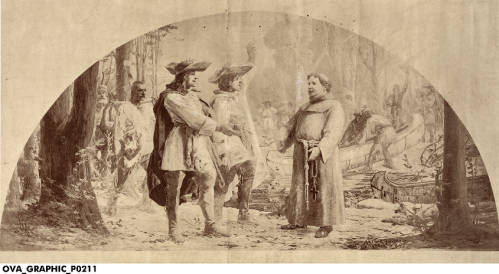
LaSalle at the Portage Landing, St. Joseph River, Dec. 5, 1679, by Arthur Thomas, 1899 General Print and Lithograph Collection, IHS
Indiana’s French Roots
Present day Indiana was once known as Nova Francia (New France) from 1534 until 1763. In the 1600s the French, most notably Jesuit missionaries and explorers, were the first Europeans to have contacted indigenous peoples in what is present day Northern Indiana. The first French settlements consisted of trading posts and military garrisons (forts). The French came to North America due to the fur trade. As European beavers had been hunted to near extinction by the 16th century, North America and Nova Francia was a new lucrative venture. Fur was the main economic driver in France and throughout Europe. In 1534 Jacques Cartier lead an exploration of the Gulf of St. Lawarence (Canada) which is near the Great Lakes, eventually bringing them to present-day Northern Indiana.
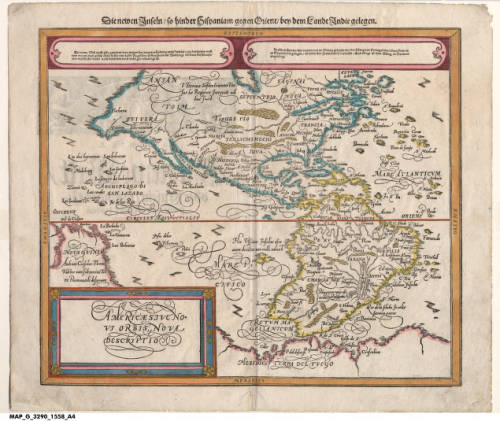
Americae Sive Novi Orbis, Nova Descripto Map, by Abraham Ortelius, 1588 Map Collection, IHS
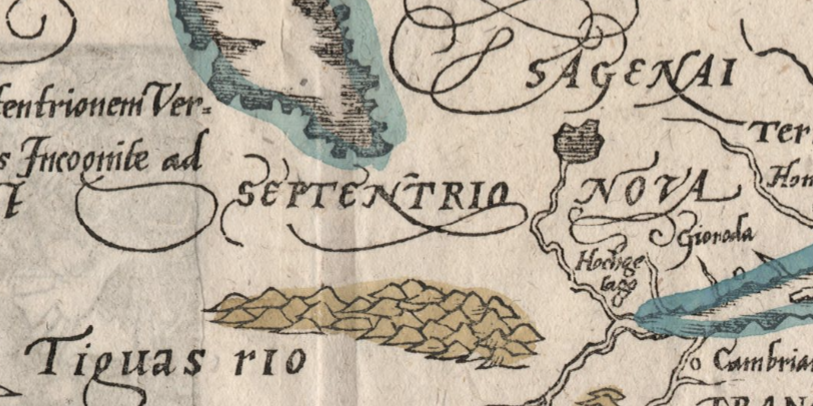
Indiana would be in the Septentrio Nova section, meaning “New North” in Latin. The blue lake is believed to be one of the Great Lakes.
[Cropped] Americae Sive Novi Orbis, Nova Descripto Map, by Abraham Ortelius, 1588
Map Collection, IHS
First European contact for the purpose of trade and exploration was made in the late 1670s by Jesuit missionaries and French explorers. Notably, Robert de La Salle (Rene-Robert Cavalier de la Salle) initiated contact with the Miami (Myaamia) peoples in Northern Indiana on the St. Joseph River (Sakiwasipi – a word used by both Potawatomi and Miami Tribes). The St. Joseph River or the Miami River referred to by La Salle is near the present day southern Michigan border.
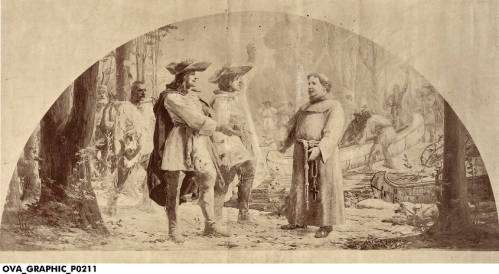
LaSalle at the Portage Landing, St. Joseph River, Dec. 5, 1679, by Arthur Thomas, 1899 General Print and Lithograph Collection, IHS
Allies in Trade and Protection
The first French settlements in what is now Indiana were forts- Fort Ouiatenon in 1717, built across from a Wea tribe village (present-day Lafayette) and Fort St. Phillippe (Fort des Miamis) in 1722 built near Kekionga, a Miami village (present-day Fort Wayne). The French had a relationship with the indigenous tribes of Indiana reinforced through the development of a transatlantic economy, diplomacy, mutual agreements, and treaties. The tribes traded their fur pelts for cloth, tools, and weapons. Outside of fur trade, the French were allied with the Miami and helped reclaim territory that was lost to other indigenous groups.
Rougier or Hoosier?
Since French was the first European language spoken in Indiana, could the French word Rougier be in reference to skin discoloration of Europeans exposed to the elements; a sunburn, ruddy cheeks, or mottled skin? Or could this be in reference to the skin tone of indigenous people or their reverence for the color red? More broadly, the color red is used in indigenous ceremonial events or for spiritual protection. Some groups believe that red is a color that connects you to the spirit world and can be seen by their ancestors who have passed on. Red was used as a pigment for artistic uses and for objects, headdresses, clothing, face or body paint for warriors. Each tribe has its own cultural or spiritual attribution to this color.
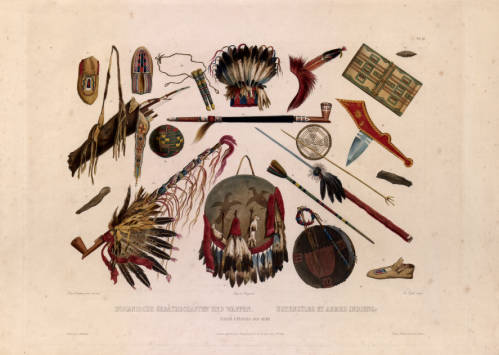
Indian Utensils and Arms, 1841 Karl Bodmer Prints Collection, IHS
Indiana’s Indigenous Tribal Use and Understanding of the Color Red
Red is one of the color quadrants of the indigenous Medicine Wheels (Hoops), each are culture specific to each tribe. Medicine Wheels represent the alignment of several states of being; physical, emotional, mental, and spiritual. The circular shape represents the interconnectivity of one with the natural world. For example, on The Potawatomi Medicine Wheel, red symbolizes the south and summer. It also represents the cedar plant which was used for purification and medicine. The Miami attributes the color to symbolize adulthood, responsibility, sacrifice and warfare.
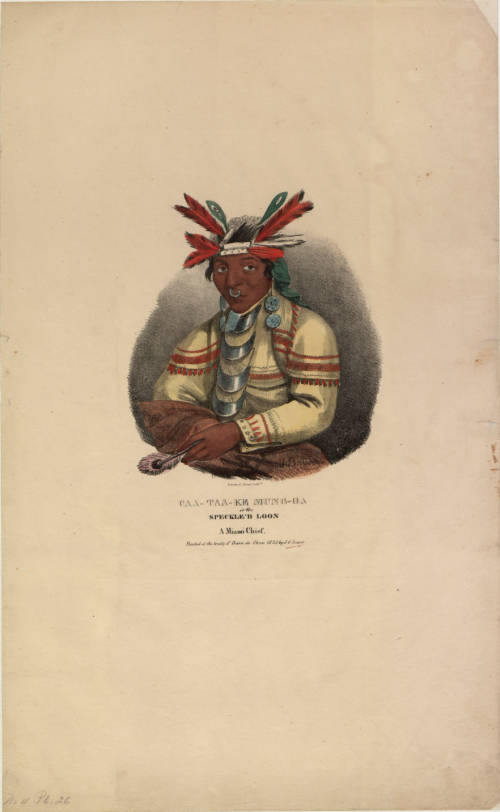
Speckle’d Loon, A Miami Chief, 1825, By James Otto Lewis The Aboriginal Portfolio, IHS
Could Rougier evolved into the word Hoosier with the meaning lost due to changing colonial powers and the passage of time? We may never know the true origin of the word Hoosier, but it for sure will continue to be a part of Indiana lore.